1. The Certificate Is the Starting Point, Not the Finish Line
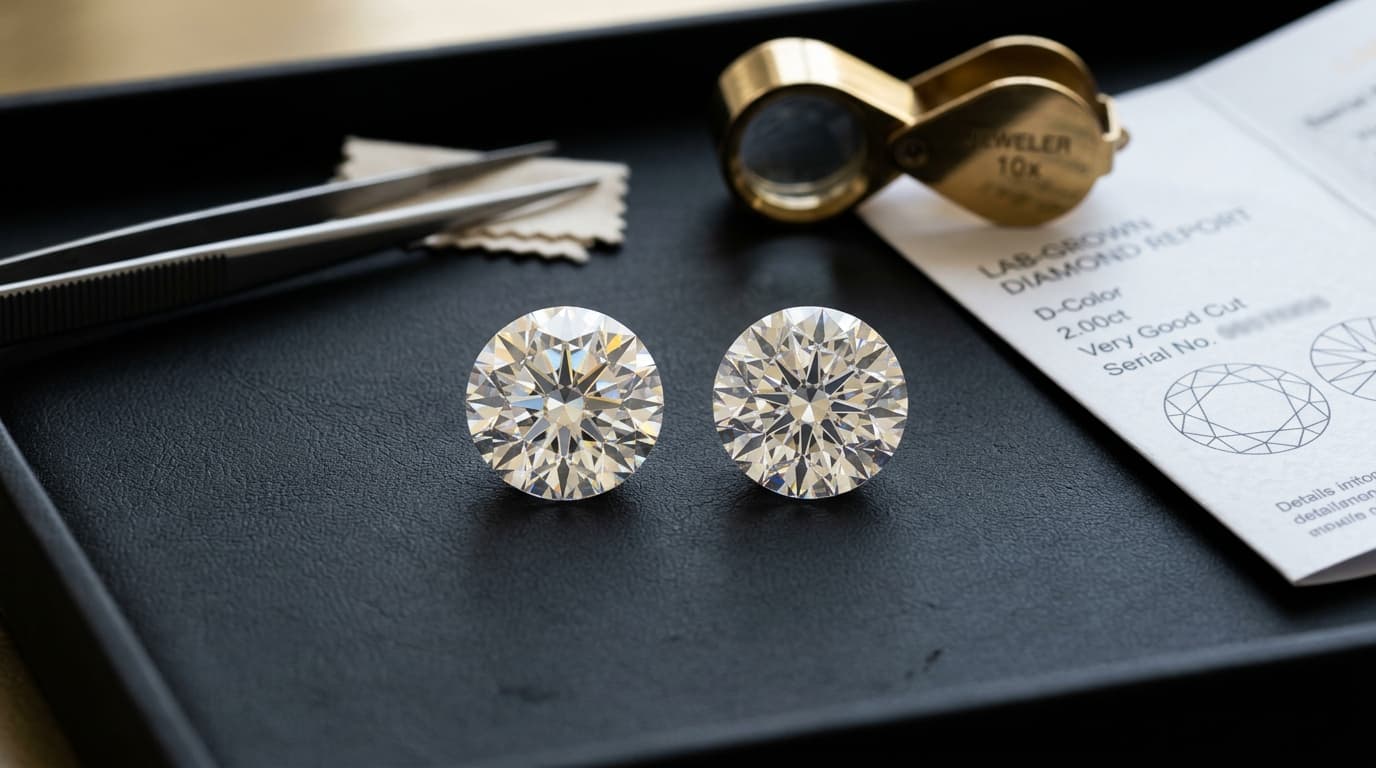
Imagine placing two 2.00-carat, D-color, VVS1 lab-grown diamonds side by side on a gemological sorting pad. On paper, their grading reports appear virtually indistinguishable: identical weight, top-tier color, immaculate clarity, and independent certification from accredited gemological institutes.
Yet once you pick up the tweezers and examine them under standard daylight-balanced lighting, one stone immediately commands attention. It shows crisp, balanced scintillation across the entire crown, returning bright, distinct flashes as it moves. The other stone seems slightly subdued—perhaps showing a darker core, slightly sluggish reflections toward the corners, or an outline that feels narrower than expected.
This contrast illustrates a fundamental reality known to experienced diamond cutters and wholesalers: the 4Cs provide a standardized language for classifying diamonds, but they do not describe every dimension of face-up visual character.
Independent laboratory grading reports—such as those issued by IGI and GIA—are essential. They verify laboratory growth provenance (confirming Chemical Vapor Deposition growth and Type IIa purity), record microscopic laser inscriptions, and deliver impartial color and clarity ratings. Without a certificate, establishing fair commercial trade would be impossible.
However, a grading report is primarily a technical classification document, not an aesthetic evaluation. While standard round brilliants receive an overall cut grade based on established proportion models, fancy shapes generally do not receive an overall cut grade on standard reports. For fancy cuts, the certificate lists measurements, table and depth percentages, polish, and symmetry—leaving optical performance and visual balance to professional inspection.
2. Carat Weight Measures Mass, Not Visible Size
One of the most persistent assumptions among diamond buyers is that carat weight directly dictates how large a diamond appears. In reality, a carat is strictly a unit of weight—exactly 0.200 grams—not a measurement of surface area or physical diameter.
Where that mass is distributed during rough planning and faceting determines the diamond's face-up footprint (often referred to in the trade as 'spread').
If a cutter plans a rough crystal to retain maximum weight rather than optimal proportions, excess mass can be hidden in a steep crown, an overly deep pavilion, or an excessively thick girdle. A 2.00-carat stone cut with excessive depth may measure 7.80 mm in diameter, whereas a 2.00-carat stone with calibrated proportions might measure 8.15 mm—delivering a visibly larger face-up presence with superior light performance.
This consideration directly connects to the economics of rough diamond planning. During 3D laser mapping in Surat manufacturing facilities, planners evaluate trade-offs between yield retention and proportion calibration. Cutting a stone too shallow to chase spread creates light leakage (the 'fisheye' effect), while cutting too deep creates dark, dead centers (the 'nailhead' effect). Proportions require precise optical equilibrium.
- Total Depth Percentage: The ratio of diamond depth to average width; excessive depth hides weight below the setting line, while insufficient depth causes light leakage.
- Table Percentage: The width of the top table facet relative to the stone's width; governs the balance between white light return (brilliance) and spectral dispersion (fire).
- Girdle Thickness: Excessive girdle thickness adds hidden carat weight without contributing to face-up surface area or optical reflection.
3. Proportions, Light Return, and Optical Contrast
A polished diamond functions as a complex three-dimensional prism. Light enters through the crown facets, travels into the pavilion, reflects internally off opposing pavilion walls at specific critical angles, and refracts back through the table to the viewer's eye.
When crown and pavilion angles are harmonized (for instance, a 34.5° crown angle paired with a 40.8° pavilion angle on a round brilliant), light returns efficiently with minimal leakage through the bottom.
However, light return alone is not the sole component of visual beauty. A stone that returns uniform white light across every facet simultaneously can look flat and uninteresting. What gives a diamond its lively, dynamic sparkle is contrast.
Contrast refers to the deliberate pattern of bright reflections interspersed with darker reflections created by the viewer's head and surrounding environment. As the diamond moves, these alternating light and dark zones create scintillation. If proportion geometry is poorly aligned, the contrast pattern becomes chaotic or extinct, resulting in large dark patches that fail to respond under light.
“True optical life in a diamond comes from the dynamic interplay of bright light return and crisp contrast needles as the stone moves in hand.”
4. Why Fancy Shapes Magnify Visual Differences
While round brilliant diamonds follow standardized symmetry models, fancy shapes (Ovals, Pears, Emeralds, Radiants, Cushions) offer extensive geometric freedom. Consequently, two fancy-cut stones with identical 4C grades can present entirely distinct visual personalities.
- Oval Cuts (Bow-Tie Dynamics & L/W Ratios): Because ovals are elongated, the pavilion facets beneath the center meet at steeper angles than those at the rounded ends. A subtle bow-tie pattern is a natural optical feature that gives an oval depth; however, an improperly cut pavilion creates a heavy, dark extinction zone across the center table that deadens the stone. Length-to-width ratios (ranging from 1.33 to 1.50) also alter whether an oval looks wide and soft or slender and modern.
- Pear Cuts (Outline Symmetry & Shoulder Balance): Pear cuts combine a rounded end with a tapered point. Beyond bow-tie intensity, two pears of the same weight can have completely different silhouettes—one featuring graceful, flowing shoulders and another showing flat, triangular flanks or a heavy, boxy head.
- Emerald Cuts (Step-Cut Transparency & Windowing): As step cuts with broad, parallel rectangular facets, emerald cuts act as open architectural windows into the diamond crystal. Without the high-frequency sparkle of brilliant faceting to disguise optical flaws, emerald cuts rely entirely on precise step symmetry. If pavilion angles are cut too shallow, the stone suffers from 'windowing'—allowing light to pass straight through like clear window glass rather than reflecting back crisp hall-of-mirrors flashes.
- Radiant Cuts (Standard Brilliant vs. Modified Crushed-Ice): Two radiants graded identically as 'Cut-Cornered Rectangular Modified Brilliant' can exhibit polar opposite optical personalities. A standard radiant features long, unbroken pavilion mains that produce large, bold flashes of brilliance. A modified crushed-ice radiant incorporates auxiliary break facets that fracture light into thousands of needle-like micro-sparkles. Neither cutting style is inherently superior, but their visual expressions are distinctly different.
5. Facet Architecture: The Information Behind the Shape Name
A grading certificate lists a trade shape name—such as 'Oval Brilliant' or 'Rectangular Modified Brilliant'—but that label is a broad category, not an exact geometric blueprint.
Lapidary master cutters in Surat utilize varying facet arrangements, pavilion tiering, and chevron configurations to achieve specific visual goals or maximize rough CVD crystal morphology.
For example, a cushion cut can be faceted as a 'Cushion Brilliant' (showing broader facet reflections reminiscent of antique cuts) or a 'Cushion Modified' (incorporating extra facet breaks for intense scintillation). Similarly, princess cuts can be polished with two, three, or four chevron tiers along the pavilion, altering both the size and speed of light flashes.
Understanding that facet architecture varies within the same nominal shape helps professional buyers look beyond the headline category to evaluate the actual facet blueprint.
6. Clarity Grade vs. Inclusion Location & Relief
Clarity grading assesses the size, nature, quantity, and position of internal characteristics (inclusions) and surface blemishes under 10x magnification. Two diamonds can earn the exact same VS1 or VS2 grade while offering completely different real-world viewing experiences.
Inclusion placement is critical. A microscopic crystal located near the outer girdle edge under a bezel facet is often completely invisible in finished jewelry, easily concealed beneath a prong or bezel setting. The exact same inclusion positioned dead-center beneath the open table facet can be more noticeable or reflect across multiple pavilion facets.
Inclusion relief—the contrast between the inclusion and the surrounding host diamond lattice—is equally important. A translucent white feather or pinpoint is far less perceptible than a dark, opaque graphite crystal, even when both receive the identical clarity grade on a laboratory report.
This distinction does not imply laboratory grading is inconsistent; it simply highlights that clarity grades represent an overall threshold rather than a guarantee of identical visual presentation.
7. High-Resolution Video as an Indispensable Evaluation Tool
In modern B2B wholesale and bespoke jewelry manufacturing, 360-degree high-definition video has become an essential companion to the physical grading certificate.
A calibrated 360-degree video captures dynamic characteristics that static 2D certificate plots cannot convey: facet tilt response, bow-tie extinction across rotation angles, step-cut windowing transparency, and real-world face-up contrast distribution.
However, video evaluation requires its own professional discernment. Video appearance is influenced by camera sensor calibration, rotational speed, diffused ambient light versus direct spotlighting, and background reflection surfaces.
Video should be treated as valuable corroborating evidence rather than an absolute, standalone grading instrument. The most reliable evaluations combine certificate metrics, high-resolution motion video, and direct millimeter dimension analysis.
8. The 3.00 ct Threshold: Weight Retention vs. Visual Proportions
In diamond manufacturing, commercial pricing benchmarks—such as the 1.00 ct, 2.00 ct, and 3.00 ct thresholds—create significant commercial incentives to retain rough weight during cutting.
Consider the following hypothetical example (illustrative comparison, not Colar Diamonds production data):
- Diamond A (3.01 ct): Planned to cross the 3-carat benchmark. The cutter retained extra weight by leaving a 68.5% total depth and a slightly thick girdle. Its face-up millimeter measurements are 9.10 × 6.60 mm.
- Diamond B (2.92 ct): Planned from a similar CVD rough plate, but polished to optimized proportions with a 62.5% depth. Its face-up millimeter measurements are 9.35 × 6.80 mm.
9. What Professional Diamond Buyers Compare: An Evaluation Checklist
When sourcing loose lab-grown diamonds for fine jewelry collections, master jewelers and B2B buyers look beyond headline 4C metrics to evaluate the complete physical stone:
- Actual Millimeter Dimensions: Length, width, and depth in millimeters to evaluate face-up spread relative to carat weight.
- Total Depth & Table Percentages: Proportions calibrated to proven light-return ranges for the specific shape.
- Length-to-Width (L/W) Ratio: Ensuring the outline matches desired silhouette proportions (e.g., 1.35–1.45 for classical ovals; 1.40–1.50 for emerald cuts).
- Outline Symmetry & Curvature: Balanced shoulders, uniform wings, and crisp corner facets without flat spots.
- Facet Pattern & Architecture: Confirming whether the pavilion structure delivers bold brilliant flashes or fine modified shimmer.
- Contrast Pattern & Extinction: Inspecting for balanced scintillation without excessive dark bow-ties or dead zones.
- Windowing & Transparency: Verifying that light reflects back to the eye rather than washing out through the pavilion.
- Inclusion Placement & Relief: Checking that clarity characteristics sit away from the center table and do not interfere with facet reflections.
- 360-Degree Motion Video: Observing scintillation speed, fire dispersion, and optical liveliness under rotation.
10. Sources & Further Reading
1. Gemological Institute of America (GIA) — 'Evaluating Diamond Cut Quality, Proportions, and Light Performance': Gemological technical monographs on crown/pavilion angle interactions, ray tracing, and face-up brilliance.
2. International Gemological Institute (IGI) — 'Laboratory-Grown Diamond Grading Criteria & Proportion Standards': Official laboratory guidelines on CVD diamond classification, 4Cs measurement protocols, and digital certificate verification.
3. Gemological Institute of America (GIA) — 'Gems & Gemology Research: Fancy-Cut Diamond Proportions and Visual Appearance': Research studies examining bow-tie effect, windowing, and facet symmetry across fancy diamond shapes.
4. International Gemological Institute (IGI) — 'Diamond Optical Symmetry, Polish, and Scintillation Analysis': Technical documentation on 3EX proportion grading, facet junction alignment, and optical contrast dynamics.
11. Final Thought: Buying the Diamond, Not Just the Paper
An independent grading certificate from an accredited gemological laboratory is an essential, non-negotiable safeguard. It provides verified proof of Chemical Vapor Deposition origin, Type IIa purity, and an impartial baseline of color and clarity.
However, when two diamonds achieve identical grades on paper, the deciding factor is how those crystals were planned, proportioned, and polished by the lapidary artisan.
The guiding principle for any discerning jeweler or buyer is straightforward: buy the certificate and the diamond together—never the certificate in place of the diamond.
A certificate tells you what a diamond is; visual evaluation reveals what it can do under light.