1. It's Tech, Not Magic: The Flat-Screen TV Effect
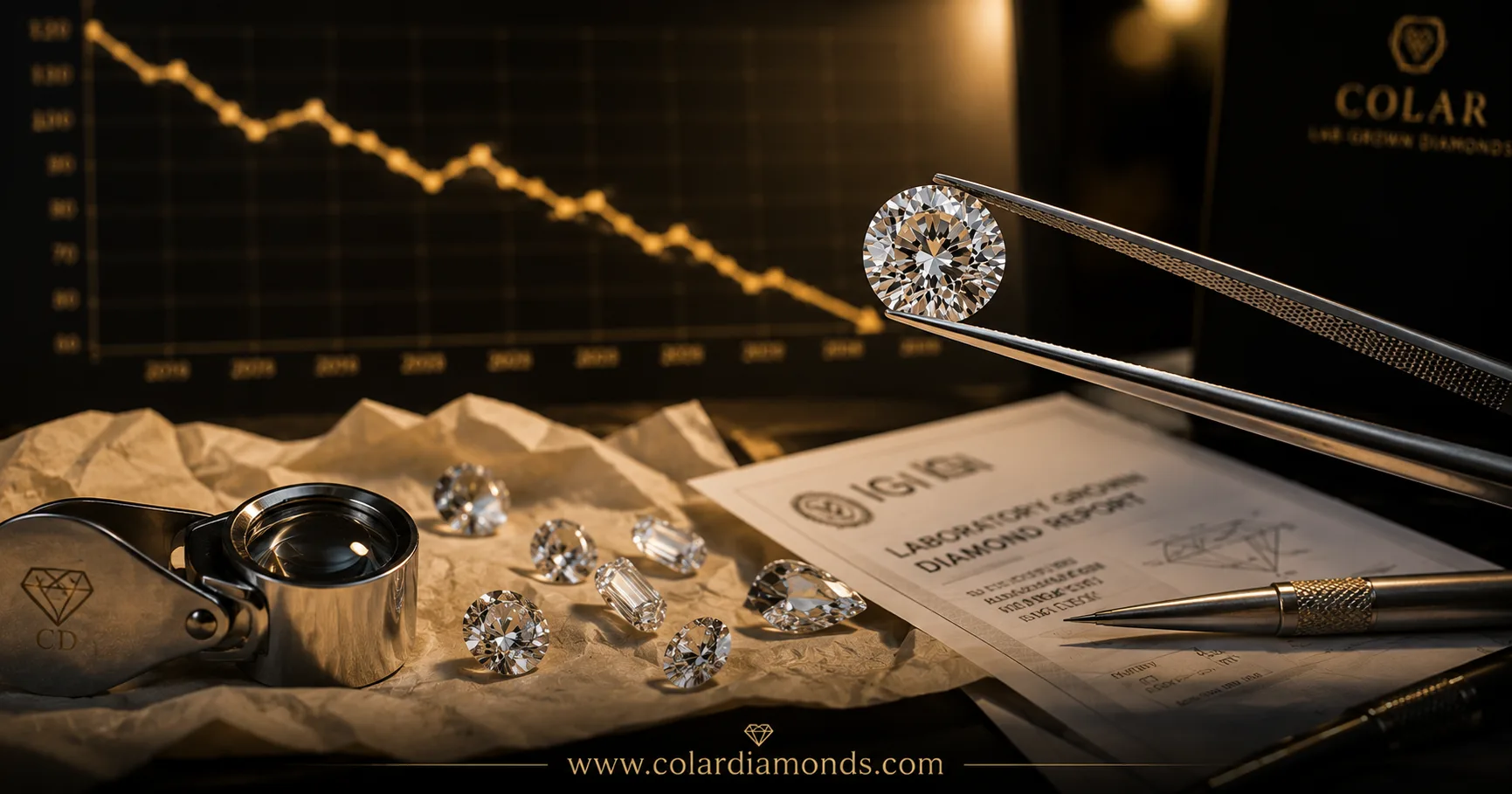
Think back to the early days of flat-screen TVs. A 50-inch television once cost several thousand dollars. Today, a better 4K model is available for a fraction of the price—not because televisions became lower quality, but because manufacturing became dramatically more efficient.
Lab-grown diamonds are following a remarkably similar path. A decade ago, running a Chemical Vapor Deposition (CVD) plasma chamber required astronomical energy costs and high failure rates. Today, modern CVD reactors achieve higher production yields, improved consistency, and significantly lower defect rates, dropping the raw cost per carat.
Like many advanced technologies, the cost of producing lab-grown diamonds has declined as manufacturing processes have become more efficient and scalable.
2. Surat's Scaling Power: Vertically Integrated Efficiency
Surat processes the vast majority of the world's diamonds and has also become a major hub for lab-grown diamond manufacturing.
Over the past few years, Indian growers and lapidary masters invested heavily in scaling up state-of-the-art CVD reactors right next to their polishing facilities.
Today, many manufacturers operate under vertically integrated models, where growing, cutting, polishing, quality control, and global distribution are managed within the same organization. This reduces logistical costs, shortens lead times, and improves consistency across the entire supply chain.
- Surat has strengthened its position as a global leader in both natural and lab-grown diamond processing.
- High-quality Type IIa diamonds contain extremely low levels of nitrogen impurities, making them among the purest gem-quality diamonds available.
- Direct-to-jeweler supply models pass efficiency savings to end consumers.
3. What Hasn't Changed? (The Fundamental Science)
Even though prices have declined due to manufacturing scale, several core physical and optical characteristics remain exactly the same:
- Same crystal structure as mined diamonds (3D carbon cubic lattice)
- Same hardness (10 on the Mohs scale), making diamonds among the hardest naturally occurring materials
- Same brilliance and fire (Refractive Index of 2.42)
- Same optical dispersion (0.044)—the exact optical property that creates a diamond's colorful flashes of light
- Same fundamental chemical composition
- Same independent grading standards (IGI / GIA)
4. Why This Is Great News for Jewelry Buyers
In most cases, no. Lower prices are primarily the result of manufacturing efficiencies rather than reduced diamond quality. An IGI-certified D color, VVS1 clarity diamond grown today is chemically and optically identical to one grown five years ago.
In many cases, buyers who previously budgeted for a small natural diamond can now choose a significantly larger IGI-certified lab-grown diamond without increasing their budget.
5. Will Prices Continue to Fall? (Market Outlook)
The answer isn't simply yes or no.
Standard commercial-quality lab-grown diamonds may continue to become more affordable as production technology improves and manufacturing capacity expands. However, exceptional diamonds—including large carat sizes, rare fancy colors, and precision-cut stones—are expected to maintain stronger pricing due to limited supply and continued demand.
For buyers, this means the best time to purchase depends less on waiting for lower prices and more on choosing the right combination of cut quality, certification, and craftsmanship.
6. Conclusion: Focus on Craftsmanship & Value
The decline in lab-grown diamond prices is not a sign of lower quality—it's a reflection of how quickly technology has evolved. As CVD manufacturing continues to improve, buyers benefit from greater choice, larger carat sizes, and exceptional value.
Ultimately, the quality of a diamond is determined by its cut, color, clarity, certification, and craftsmanship—not simply by its price tag. Whether you're a retailer sourcing inventory or a consumer choosing an engagement ring, understanding these factors will help you make a more informed decision.