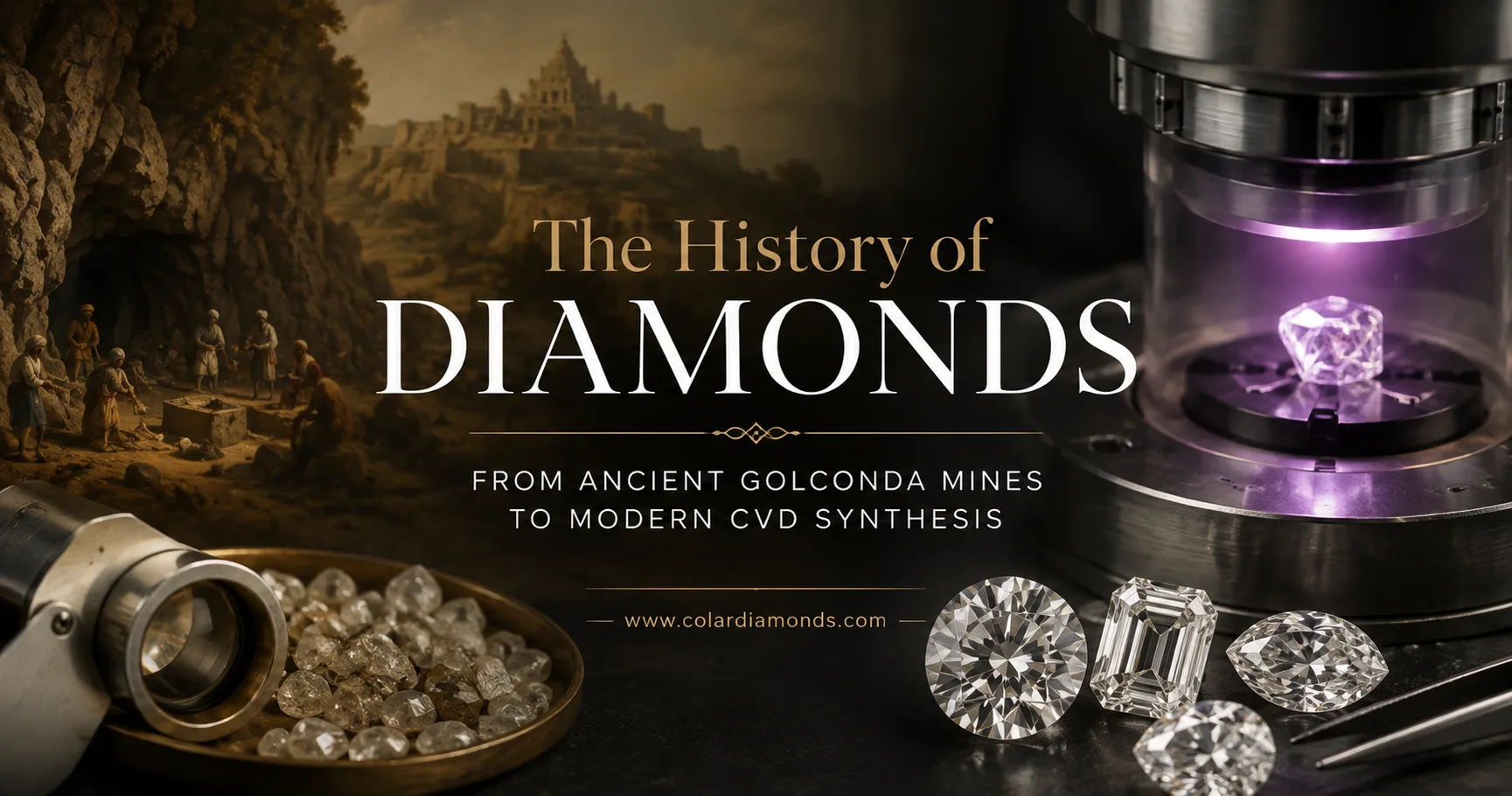
1. The Ancient Origins: Golconda, India (4th Century BCE)
Long before modern geological extraction, the history of diamonds began in ancient India along the riverbanks of the Krishna and Godavari rivers in Golconda (modern-day Telangana & Andhra Pradesh).
For over two millennia, India was the world's exclusive source of diamonds. Golconda diamonds became world-famous for their unparalleled optical clarity—a property gemologists now recognize as Type IIa chemical purity, representing less than 2% of all natural diamonds.
“Historical legends like the Koh-i-Noor, Hope Diamond, and Regent Diamond all originated from ancient Golconda mines in India.”
2. The Global Shift: Brazil, South Africa, and Cartel Supply Chains
In the 18th and 19th centuries, India's alluvial mines reached depletion, leading to discoveries in Minas Gerais, Brazil, and later the massive volcanic pipe mines of Kimberley, South Africa.
The 20th century witnessed the rise of centralized mining cartels, which controlled global rough supply, manipulated retail pricing, and created artificial scarcity through single-channel distribution networks.
- 1720s: Discovery of alluvial diamonds in Minas Gerais, Brazil.
- 1867: Discovery of the Eureka diamond in Kimberley, South Africa, launching open-pit mining.
- 1930s-1990s: Single-channel cartels controlling up to 90% of global rough diamond distribution.
3. The CVD Technological Revolution: Returning to Indian Soil
In the 21st century, material science achieved what alchemists sought for centuries: synthesizing pure 100% carbon diamond crystals without subterranean open-pit mining.
Surat, India—long recognized as the cutting and polishing capital of the world—has become the global hub for Chemical Vapor Deposition (CVD) synthesis. By ionizing methane and hydrogen plasma inside microwave chambers, master technicians recreate Golconda-grade Type IIa diamonds layer by atomic layer.