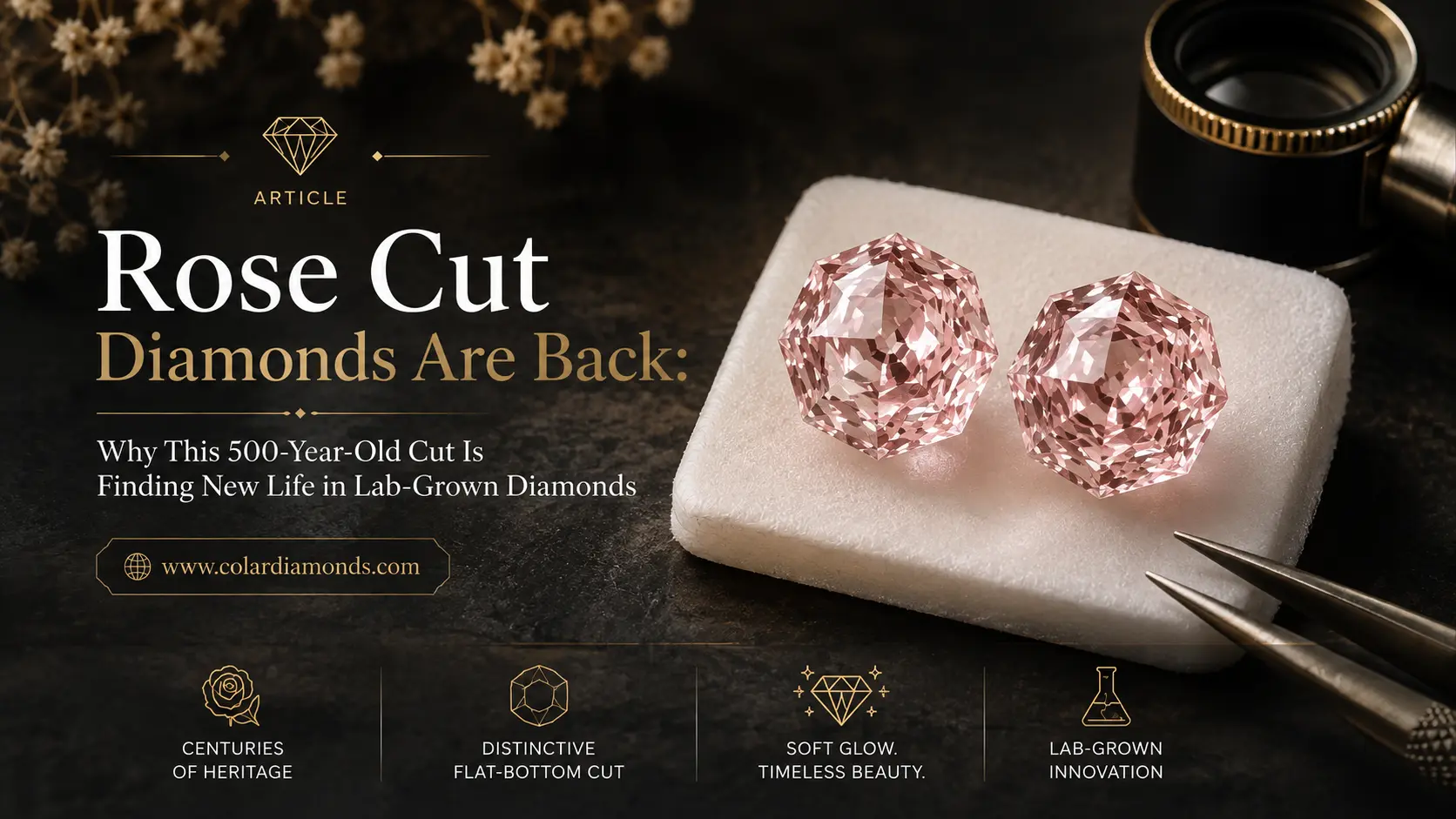
1. A Diamond Cut From Another Era
A rose cut diamond breaks one of modern diamond cutting's biggest conventions: it isn't trying to sparkle like a brilliant cut.
Instead of a deep pavilion and dozens of facets engineered for intense light return, a traditional rose cut typically has a flat base and a domed crown covered with triangular facets. The result is softer and more understated—broad flashes of reflected light, transparency, and a distinctive glow.
It is a historic concept finding a natural place in modern jewelry. And with lab-grown diamonds giving designers more freedom to experiment with size, outline, and custom cutting, the rose cut is becoming widely explored all over again.
Rose cuts date back several centuries, becoming prominent in European jewelry from the mid-16th century onward, long before electric lighting and modern precision cutting. The name comes from their appearance: viewed from above, the triangular facets can resemble the overlapping petals of a rosebud.
Traditional examples were cut by hand and varied considerably. Rather than the standardized geometry associated with modern brilliant cuts, antique rose cuts often carried subtle variations that reflected the tools and craftsmanship of their period.
They were also designed for a very different world. Historical jewelry was viewed under daylight, candlelight, and firelight. Instead of producing the intense scintillation expected from a modern round brilliant, rose cuts offered larger, softer flashes as the stone moved. That distinctive visual character remains one of their greatest attractions today.
2. Rose Cut vs Brilliant Cut: Different Optical Philosophies
Comparing a rose cut with a modern brilliant cut purely on sparkle misses the fundamental purpose of the design.
A brilliant-cut diamond uses a crown and pavilion engineered to direct light through a complex system of internal reflections. Its beauty is strongly associated with brightness, fire, and rapid scintillation.
A traditional rose cut behaves differently. Because it generally lacks the deep pavilion of a brilliant cut, its personality comes primarily from the facets across its domed upper surface.
- Brilliant Cut: Engineered with a deep pavilion and dozens of facets to maximize internal light return, fire, and rapid multi-facet scintillation.
- Rose Cut: Features a flat base and domed crown with fewer triangular facets, prioritizing glassy transparency, broad reflections, and an antique glow.
- Optical Focus: Brilliant cuts maximize internal reflections; rose cuts celebrate surface geometry, light transmission, and distinct silhouette.
3. Why Rose Cuts Feel Modern Again
The contradiction is part of their appeal: a centuries-old cut can look surprisingly contemporary when placed in a minimal modern setting.
Rose cuts work particularly well in jewelry that seeks a distinctive, tailored appearance. Their lower profile can suit delicate rings, bezel settings, pendants, earrings, and unconventional engagement jewelry.
Designers also aren't limited to traditional round stones. Modern rose cuts can be fashioned in an array of geometric outlines:
- Oval & Pear Outlines
- Cushion & Marquise Shapes
- Hexagon, Kite & Shield Geometries
- Freeform, Portrait & Custom Bespoke Outlines
4. The Face-Up Size Advantage
One of the most interesting characteristics of a rose cut is how it distributes its weight.
A conventional brilliant diamond carries a significant portion of its mass in the pavilion below the girdle.
A traditional flat-bottom rose cut does not. As a result, a rose cut can often have a larger face-up footprint for its carat weight than a deeper brilliant-style diamond.
However, this should not be interpreted as a universal rule. Two one-carat rose cuts can have very different dimensions depending on their dome height, outline, and proportions. Carat remains a measure of weight, not visible spread.
The most effective way to evaluate a rose cut is to examine its actual millimeter dimensions alongside its weight. For jewelry designers, that can create interesting possibilities: a visually substantial diamond without concentrating a large amount of weight beneath the setting.
5. Why Lab-Grown Diamonds Make Rose Cuts Interesting
Lab-grown diamonds don't change what a rose cut is; they expand what manufacturers and designers can realistically explore.
Larger diamond material and custom cutting can be planned without the same rarity economics and rough constraints associated with comparable natural diamond rough.
That opens the door to oversized rose cuts, unusual geometric outlines, matched layouts, and jewelry designs that might otherwise be commercially challenging to produce.
For a manufacturer, it also creates an opportunity to approach the rough differently. Instead of asking only 'How do we produce the highest-yield conventional shape?', the planner can evaluate what cut best utilizes the natural form and crystal orientation of a specific CVD rough plate.
Sometimes the answer may be a radiant or oval. Sometimes it may be a distinctive rose cut.
6. A Simple Cut Doesn't Mean an Easy Cut
Rose cuts can look deceptively simple. While there are fewer facets than in modern brilliant designs, precision remains essential.
In fact, a simpler facet pattern can make minor asymmetries or misaligned facet junctions easier to notice. The cutter must carefully consider:
- Outline — Is the shape visually balanced and proportional?
- Facet alignment — Do the triangular facets meet cleanly at crisp vertices?
- Symmetry — Does the dome appear intentional and uniform rather than uneven?
- Crown height — Is the crown proportion calibrated for the desired balance of spread and optical reflection?
- Transparency — Does the diamond exhibit clean, unobstructed crystalline transparency?
- Polish — Are the broad facet surfaces finished smoothly without drag lines?
7. Clarity Matters Differently in a Rose Cut
Clarity is an important consideration for buyers and jewelers evaluating rose cuts.
Brilliant cuts generate complex reflections that can often make certain internal characteristics less noticeable during normal viewing. A rose cut, by contrast, is more transparent.
Because there is no deep pavilion producing an intense optical pattern, inclusions may be easier to see directly through the body of the stone.
That does not mean every rose cut requires a flawless clarity grade. It means inclusion placement and visual appearance matter. A stone with a small characteristic positioned near the perimeter or beneath a facet junction may remain completely eye-clean, whereas a similar inclusion positioned directly beneath an open central facet may be more visible.
8. Rough Planning & Modern Modified Rose Cuts
Rose cuts present an interesting manufacturing consideration: how should the rough crystal be utilized?
Modern 3D planning software evaluates rough dimensions, internal characteristics, and potential cutting orientations before polishing begins. However, the highest weight-retention solution is not always the most attractive rose cut. The planner may decide to sacrifice some carat weight to optimize outline, symmetry, crown profile, facet placement, and inclusion positioning. This is where software and lapidary craftsmanship work together.
Furthermore, modern cutters often explore modified rose cuts rather than strictly recreating historic antique stones. Contemporary designs may adjust facet counts, modify dome curvature, or combine rose-cut crown facets with geometric step-cut elements.
For designers, that flexibility allows the visual language of a centuries-old cutting style to be adapted into fresh, modern jewelry forms.
9. Who Is a Rose Cut Actually For & Inspection Checklist
Rose cuts are suited for specific aesthetic preferences. If the primary priority is maximum sparkle and intense scintillation, a brilliant-style diamond will generally be the preferred choice.
A rose cut is worth considering if you value:
- Historic character and vintage aesthetic
- A distinctive, non-traditional silhouette
- A larger face-up presence for a given carat weight
- Softer light reflections and glassy transparency
- Low-profile jewelry settings, bezel mounts, or flush bands
- Unusual geometric and custom-cut shapes
- Bespoke design versatility
10. Sources & Further Reading
1. Gemological Institute of America (GIA) — 'Diamond History & Cut Evolution': Gemological documentation on antique cutting traditions, facet development from point cuts to 16th-century rose cuts, and optical reflection characteristics.
2. Tillander, Herbert (1995) — 'Diamond Cuts in Historic Jewellery: 1380–1910': Authoritative historical monograph detailing the development, geometry, and regional variations of early European rose-cut diamonds.
3. International Gemological Institute (IGI) — 'Laboratory-Grown Diamond Grading Guidelines': Standardized gemological grading criteria, spectroscopic verification, and laser inscription standards for CVD diamonds.
4. Gemological Institute of America (GIA) — 'Gems & Gemology Research': Studies on Chemical Vapor Deposition (CVD) single-crystal growth mechanisms and Type IIa optical transparency.
11. Final Thought: Character That Technology Can't Replace
Diamond cutting has spent centuries evolving toward greater precision and increasingly complex light control. Yet one of the industry's oldest cutting styles continues to endure.
The rose cut offers an aesthetic that adding more facets cannot replicate: distinct personality. Its character is quieter, its architecture exposes more of the stone's body, and when proportions and faceting are executed with precision, the result feels both historic and contemporary.
Lab-grown diamonds have not reinvented the rose cut. They have provided cutters and jewelry designers with a broader canvas on which to explore it.
For a cut with centuries of history behind it, modern diamond manufacturing is simply opening another compelling chapter.